Smaller Than You'd Think, More Serious Than You'd Expect: Understanding Ruptured Ovarian Cysts
I don't cry at pain. After years of living with a CRPS, I've learned to put distance between myself and what my body is doing. It's a skill you develop without really meaning to.
So when I found myself crying, really crying, and unable to explain it away - I knew something was different. This wasn’t my normal. The ambulance was called when I finally accepted that what was happening in my body couldn't be attributed to anything I already knew about myself.
I just didn't know yet what it actually was.
So, what actually is a Corpus Luteal cyst?
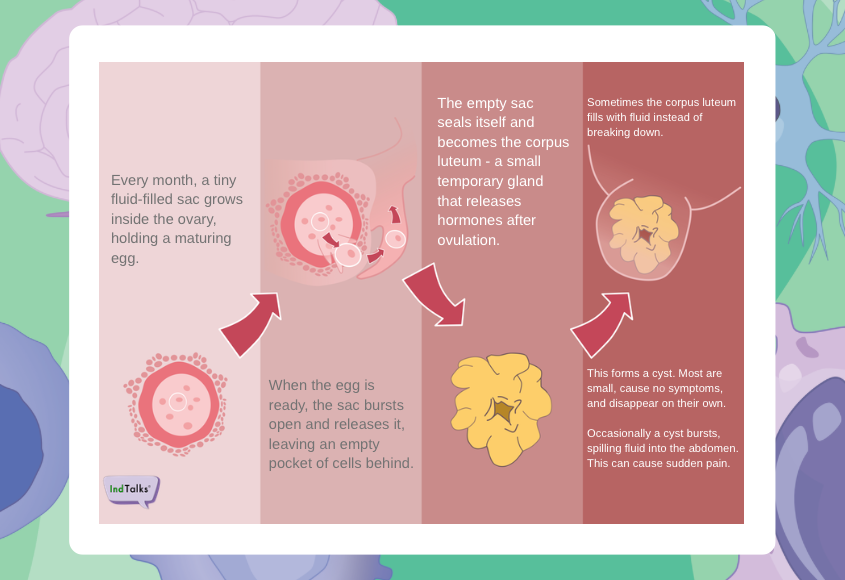
Well first let’s quickly define what the corpus luteum is! In Latin corpus luteum means “yellow body”, it is a vital yet temporary structure in the female ovaries that plays a crucial role in releasing a mature egg during ovulation.
The corpus luteum develops each time a person ovulates so that they produce numerous throughout their lifetime. The corpus luteum ultimately has 2 fates depending on whether an egg becomes fertilised.
If the egg is fertilised and implantation occurs, by day 9 the developing embryo releases a hormone called hCG - the same one detected in pregnancy tests. This signals to the corpus luteum to continue producing progesterone. If the egg is not fertilised, the corpus luteum stops secreting progesterone, without this the endometrium is no longer maintained and the lining is shed, resulting in menstruation.
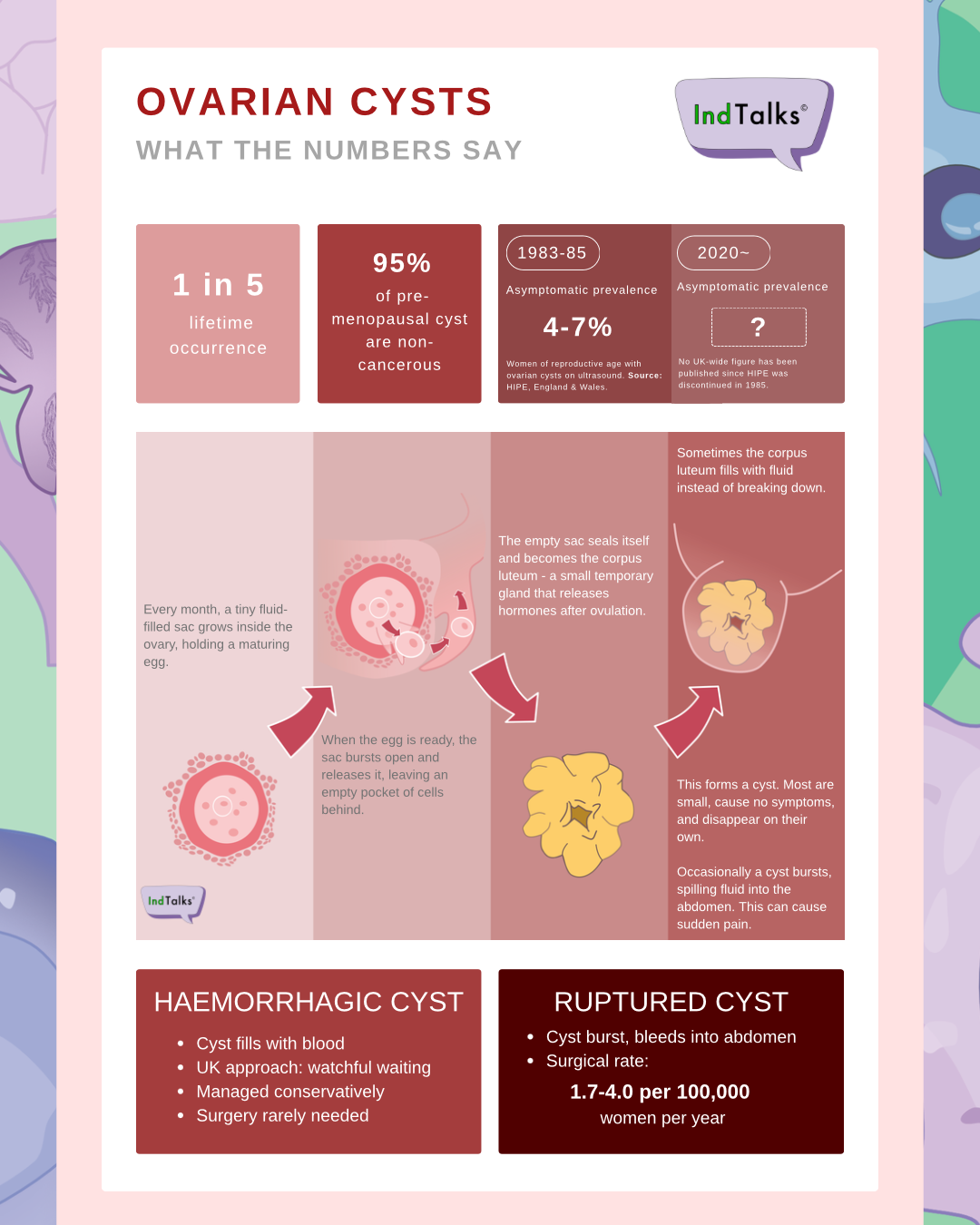
Although rare, it is possible that corpus luteum cysts develop. These cysts feature intense endocrine activity and often produce excess progesterone, however they often resolve themselves despite taking up to 3 months to shrink on their own.
In contrast, a ruptured cyst enlarges and bursts open spilling fluid and blood into the abdominal cavity.
When it ruptures - What happens?
When a corpus luteum cyst ruptures, physically the reality depends heavily on the amount of fluid or blood that was inside the cyst when it burst. Obviously this isn’t something you can determine yourself from outside of your body but it will lead to symptoms that can range from completely unnoticeable to severe.
For me personally, it was a gradual sharp pain, cramping and bloating that occurred in my abdomen, that progressively became more and more intense as time passed. I also experienced dizziness, cold sweats and shoulder tip pain.
The shoulder tip pain is something that I didn’t know is actually a critical red flag that typically requires immediate emergency medical evaluation. This is because this specific symptom strongly should have suggested that blood was leaking out of the ruptured cyst and accumulating inside my abdominal cavity.
As blood pools in the abdomen unbeknownst to me it was travelling up towards my diaphragm, when I was laying down, thereby irritating the phrenic nerve and causing referred pain.
Diagnosis - How did they know?
The preferred method to check for ruptures is typically identified through a pelvic and abdominal ultrasound, which is able to identify fluid or blood pooling in the pelvis. Additionally, blood tests are often performed to check for blood loss and monitor hemoglobin levels.
The next step after those tests, for me at least, was a CT (computed tomography) scan. CT scans play a vital role in diagnosing ruptured corpus luteum cyst with hemoperitoneum.
Drainage and removal - What the procedure involves
I’m not sure which at that time but since the bleeding was either active and/or massive an urgent minimally invasive surgery called a laparoscopy was required to drain the blood from my abdomen.
A laparoscopy is a minimally invasive procedure using a few small abdominal incisions and a camera, in order to suction and wash out the pelvic cavity to remove accumulated blood. The bleeding site on the ovary is sealed using cautery or tiny absorbable stitches.
Recovery
My recovery from this procedure wasn't straightforward, and my experience has been complicated by other ongoing health issues, so I'm not best placed to speak to what a typical recovery looks like.
What I will say is that if you're facing this procedure, your surgical team is your most important resource. Ask them every question you have, no matter how small it seems. For general recovery information, the NHS website is a reliable and accessible starting point.
What I can tell you is that the procedure itself was done and I woke up on the other side of it. Sometimes that's enough to know.
References
Cleveland Clinic. (n.d.). Corpus Luteum Cyst: Causes, Symptoms & Treatment. [online] Available at: https://my.clevelandclinic.org/health/diseases/22340-corpus-luteum-cyst.
Nyhsen, C. and Mahmood, S.U. (2014). Life-threatening haemoperitoneum secondary to rupture of simple ovarian cyst. BMJ Case Reports, 2014, p.bcr2014205061. doi:https://doi.org/10.1136/bcr-2014-205061.
Oliver, R. and Pillarisetty, L.S. (2023). Anatomy, Abdomen and Pelvis, Ovary Corpus Luteum. [online] PubMed. Available at: https://www.ncbi.nlm.nih.gov/books/NBK539704/.
Wikipedia Contributors (2026). Corpus luteum. Wikipedia.
Comments
Loading comments…